The cabinet at the Josephinum
A building that was always meant to teach
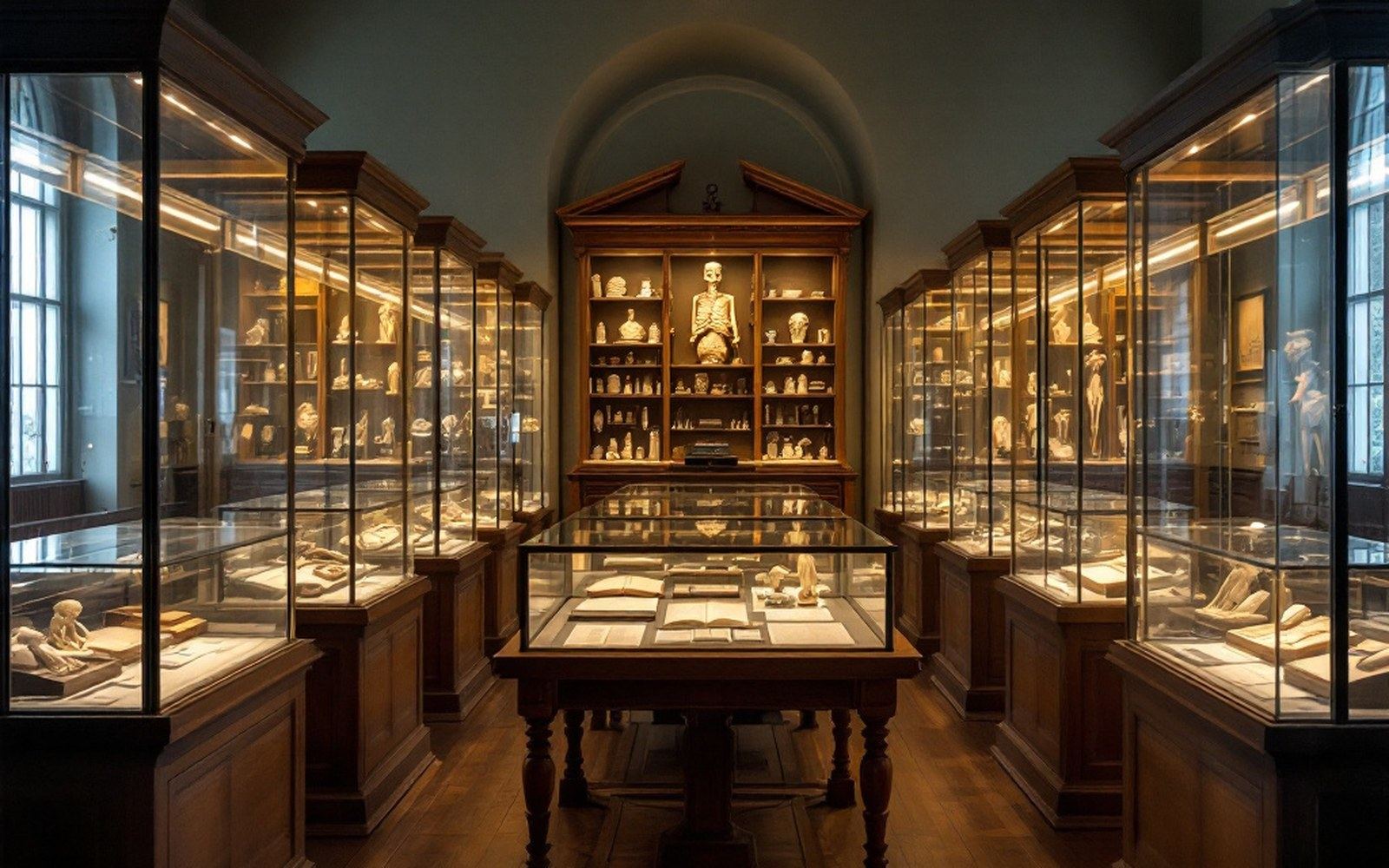
The Josephinum on the Währinger Strasse was built for instruction. Joseph II commissioned it in the 1780s as a training academy for military surgeons, and the anatomical wax models it houses were ordered at the same time — made in Florence under the direction of Felice Fontana and shipped north across the Alps in purpose-built wooden crates. Those figures, eerily precise in their rendering of the body's interior, have never left the building in any meaningful sense. They are where they were put. That stability is itself significant: the Josephinum's collection survived the nineteenth century intact, and when Viennese dermatology produced its own body of wax teaching objects — the moulages — the older institution cast a long shadow over how they were displayed, stored and understood.
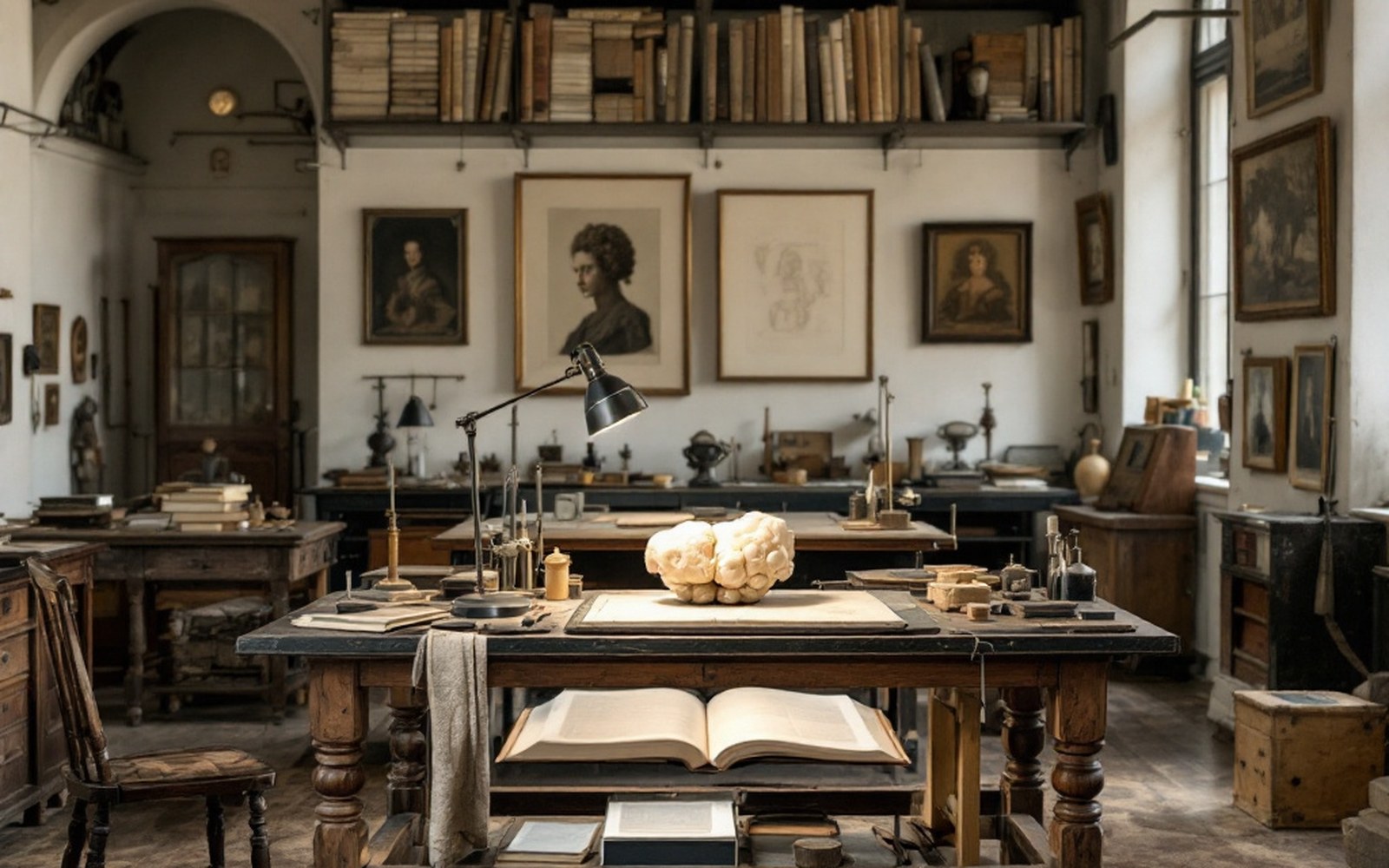
The cabinet, in the material sense, is a piece of furniture and an idea at the same time. The glass-fronted cases at the Josephinum hold their wax figures upright or reclined on silk, lit so that visitors see form and colour simultaneously. The furniture is inseparable from the pedagogical claim: looking into a case of this kind was already an act of learning, a rehearsed encounter with a body that could not speak back, could not flinch, did not die. That logic — the controlled, repeatable encounter — passed directly into the use of dermatological moulages later in the century.
Hebra, the Allgemeines Krankenhaus, and the problem of the rare case
Ferdinand von Hebra built his teaching practice at the Allgemeines Krankenhaus, the vast public hospital that gave Vienna's medicine its particular character: sheer volume. The wards were large and the patient population was drawn from across the empire, which meant that unusual presentations appeared with a regularity impossible in smaller institutions. Hebra could show students a rare condition one week and its variants the next. But the rarity was also the problem. No student could be guaranteed to encounter a given presentation during the span of a posting, and even when a case appeared it lasted only as long as the patient remained in the ward.
The moulage answered that constraint. A wax cast, taken from a patient, painted from life and stored in a cabinet, made the encounter permanent and repeatable. Hebra's department accumulated such objects over decades, building what was in effect a three-dimensional reference library of skin conditions as classified under his pathological-anatomy system — organised not by the look of a lesion but by what the underlying tissue was doing, a distinction that separated his school from every earlier approach.
The objects themselves were kept in tiered wooden cases, each cast in its own tray or shallow box, often with a paper label carrying the clinical classification in manuscript. The cabinet was not decorative in the Josephinum sense; it was working furniture, handled regularly, carried into teaching rooms, stacked and retrieved. The difference in treatment reflects the difference in origin: the Fontana models were prestige objects from the start, commissioned by an emperor and shipped in silk. The dermatological moulages were working tools made by craft workers in a hospital workshop.
Chronology
- 1780sJosephinum commissioned by Joseph II; Fontana wax models ordered from Florence
- 1856First parts of Hebra's Atlas der Hautkrankheiten issued
- 1856–c.1876Atlas issued in parts over roughly two decades
- 1872Kaposi describes the tumour named after him
- 1880 Hebra's death;Kaposi continues the moulage collection and atlas
The lithographic atlas and the limits of print
Parallel to the moulage collection, Hebra's department produced the Atlas der Hautkrankheiten — the atlas of skin diseases — issued in parts over roughly two decades from 1856. The plates were drawn by Anton Elfinger, working directly from patients, and printed by the lithographic process: image drawn onto limestone, printed in ink, then coloured by hand by workshop colourists following a master copy. The atlas was a different kind of cabinet, bound and flat, organised by the same classificatory logic as the moulage collection.
Lithography made fine tonal gradation possible in a way that woodcut or engraving could not, and the hand-applied colour brought each impression closer to the living surface. But the atlas had limits the moulage did not. A printed plate rendered two dimensions; it fixed one angle, one lighting condition, one moment in the progression of a case. A moulage cast in three dimensions could be turned in the hand, held at different angles, compared with neighbouring objects in the same cabinet. The two formats were genuinely complementary, and the dermatology department used them that way — the atlas for wide distribution by subscription, the moulage collection for teaching at close quarters.
That complementary relationship is visible in how Moriz Kaposi, Hebra's successor and son-in-law, managed both. Kaposi continued commissioning moulages after Hebra's death in 1880, and he extended the atlas. The collection as it stood by the end of the nineteenth century was thus the product of two generations of sustained effort, each adding objects in both media.
What the cabinet preserves
A moulage survives differently from a printed plate. The wax is physically unstable — sensitive to temperature, to vibration, to the oils left by handling — and the painted surface can lift, crack or yellow in ways that alter the very colour information the object was made to record. A lithographic impression, once fixed and dry, is comparatively stable; it can be folded into a gathering, shelved, forgotten and reopened a century later without having changed much. The Wellcome Collection holds printed dermatological atlases from this period that remain legible and bright. Wax collections anywhere in the world require continuous, active conservation to remain so.
The Josephinum's own wax figures — the Fontana models — are among the most studied objects in the history of anatomical teaching, partly because their survival is remarkable and partly because the silk-lined cases have protected them from the worst of the handling damage other collections suffered. The dermatological moulages held in Vienna do not have silk linings. They have the wooden trays and paper labels of a working collection, and their conservation is a present-tense problem, not a historical one.
What both collections share is the insistence that an object in a cabinet constitutes an argument. The Josephinum's anatomical figures argued, in 1785, that a surgeon could learn internal structure without dissecting a cadaver in the room. Hebra's moulage collection argued, three generations later, that a student could meet a skin condition classified under pathological anatomy without having a patient in front of them. The cabinet is the medium through which that argument is made — the furniture, the lighting, the labelling, the ordered sequence of cases.
The city of Vienna holds both claims in two institutions a short distance apart. The Josephinum's collection is now administered as a museum; its silk-lined cases are part of what visitors come to see. The dermatological moulages are a teaching archive first, a museum object second, and the distinction still shapes how they are stored, accessed and thought about. Together they make Vienna one of the few places where the full arc of wax as a teaching medium — from the anatomical theatre of the Enlightenment to the dermatology ward of the late nineteenth century — can be traced through surviving objects rather than through printed descriptions of objects that no longer exist.