The atlas came out in pieces for twenty years
Ferdinand von Hebra's Atlas der Hautkrankheiten appeared not as a book but as a slow accumulation of parts, issued across roughly two decades — which is why complete sets survive so rarely, and why no two copies are quite the same.

A publication built by instalments
The Atlas der Hautkrankheiten — the Atlas of Skin Diseases — was never meant to land on a desk in a single bound volume. It was issued in fascicles, the term then standard in German scientific publishing for separately sold gatherings of plates and text, delivered to subscribers at intervals. Each fascicle contained a small number of lithographic plates, hand-coloured after printing, together with corresponding descriptive text. A subscriber paid for each instalment as it arrived, and only at the end of the run — if the run ever reached a clean end — did he possess something that could be taken to a bookbinder and made into a coherent whole.

The publication began in the 1850s and continued through the 1860s and into the 1870s. That span is not carelessness; it reflects how difficult, expensive and slow the production of fine colour lithography actually was. Each plate required a drawn stone, careful printing, and the laborious hand-colouring that gave the images their diagnostic value. The artist Anton Elfinger was responsible for the original drawings, and the constraint was not imagination but time and craftsman-hours. A publisher could not warehouse twenty years of finished plates and release them at once; the economics of subscription publishing meant that production and distribution moved together, one fascicle funding the next.
Hebra's name appeared on the title pages, and the intellectual programme was his: a reclassification of skin disease by pathological anatomy rather than by surface appearance, which meant the atlas was not illustrating a received canon but building the visual argument for a new one. That gave the plates a theoretical weight unusual in an anatomical picture book, and it also meant the text portions could not be written until the science was settled. Some gatherings arrived late because the ideas behind them were still being worked out.
What subscription publishing did to the object
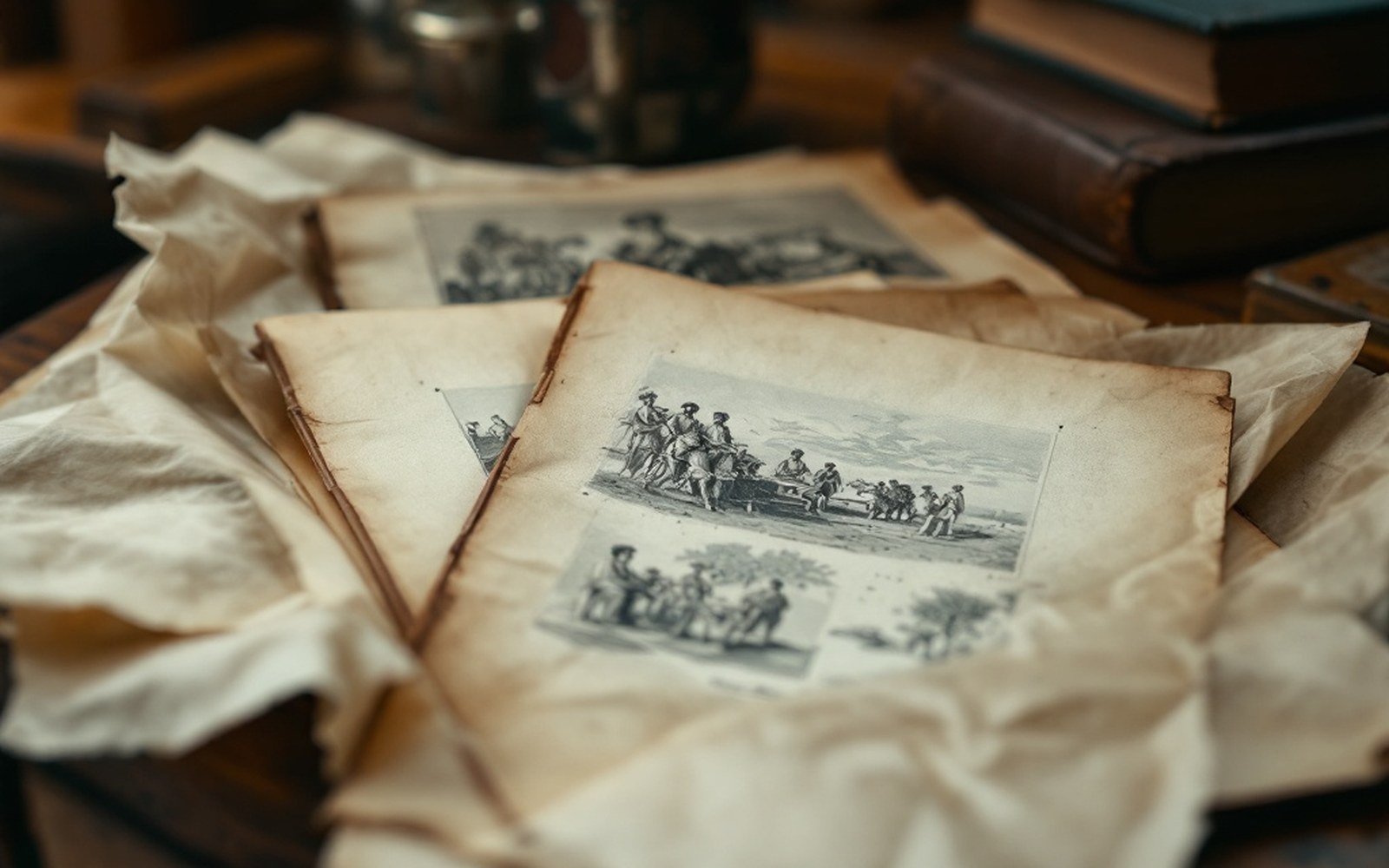
The fascicle format created a publication that is simultaneously one thing and many things. In principle, all complete copies of the Atlas contain the same plates in the same sequence. In practice, the variation is considerable. Subscribers who joined late might receive early parts in a second printing that differed in small ways from the first. Subscribers who bound their copies at different moments bound them in different configurations. Some wrapped individual gatherings in their original paper covers and had those sewn in; others discarded the wrappers entirely. Tissue guards — the thin interleaving sheets placed over plates to prevent offsetting — survive in some copies and are missing in others. Annotations made by physician-owners accumulated differently in each copy.
Publication timeline
- 1850sfirst fascicles issued under Hebra's editorship
- 1856–1876approximate span of the full publication run (individual fascicle dates vary by copy)
- 1860s–1870slater parts completed under Moriz Kaposi after Hebra's health declined
- Post-completioncopies bound mid-run remain permanently incomplete
The result is that a librarian or a collector today cannot treat any two copies as identical witnesses to the same object. The Josephinum in Vienna holds institutional examples, and copies surface occasionally in antiquarian trade and in research library holdings across Europe, but cataloguing them against one another reveals divergence at nearly every point of comparison. Which fascicles are present, whether the wrappers survive, the state of the colouring, the quality of the printing on any given stone — all of these vary. Bibliographers describe the Atlas as a complex publication, a phrase that in catalogue terms means the collation is not yet fully resolved.
The subscription model also means that complete sets are genuinely scarce. A subscriber who lost interest, died, or simply failed to renew at the right moment would hold a partial run. Partial copies were then sometimes broken up: individual plates, particularly the finest, were removed and sold separately or framed. A plate pulled from context retains its visual power but loses its place in an argument. The broader consequence is that the atlas as Hebra conceived it — a total, systematic visual statement of a reclassified discipline — now exists as an ideal reconstructed from incomplete surviving copies rather than as an easily consultable physical object.

Moriz Kaposi and the continuation
By the later fascicles, Hebra was no longer working alone. Moriz Kaposi, his son-in-law and eventual successor at the Allgemeines Krankenhaus, completed the series, carrying the intellectual programme forward under the authority of his own clinical standing. By the time the later fascicles appeared, Kaposi was already a significant figure in his own right, and the transition from one editor to another is visible in the character of the text, though the plate production maintained the standards established in the earlier parts. The Atlas's first fascicles are recorded in library holdings across Europe and North America, and the OCLC records show the variation in collation that marks any extended subscription publication.
The eventual completion of the series gave the atlas a second kind of identity: it could now be cited as a finished work with a terminus, rather than as an ongoing enterprise. But the copies assembled before that terminus arrived — the partial sets bound mid-run — had already begun their separate lives in hospital libraries, private collections and institutional holdings. Those copies do not benefit retroactively from the later fascicles. They remain, permanently, witnesses to the publication as it stood at the moment their owner stopped subscribing.
Why copies diverge
- Subscribers joined at different points, sometimes receiving earlier parts in later printings
- Paper wrappers (original fascicle covers) survive in some copies, absent in others
- Tissue guards over plates lost or retained unpredictably across copies
- Individual plates removed from broken sets and sold or framed separately
- Owner annotations and binding choices made at different moments
The photograph that did not replace it
Photography was available by the time the later fascicles appeared, but the reasons photography could not do what the lithograph did kept the older technology in service longer than one might expect. Colour rendition, tonal control, the ability to suppress irrelevant detail and emphasise a specific structural feature — all of these were better handled by a skilled lithographic draughtsman working from observation than by a photographic process tied to what the lens recorded. The Atlas thus remained a work of drawn, printed and hand-coloured images through its entire run, a choice that reflects both the limits of early photography and the particular demands of a publication whose purpose was to make an argument, not merely to document a surface.
That combination — the slow serial release, the manual colouring, the theoretical ambition, the editorial transition, the incomplete survival — makes the Atlas der Hautkrankheiten one of the more complex objects in the material history of nineteenth-century medical publishing, and one whose full bibliographic account is still being written.